Categories
Uncategorized

Comment s’affirmer sans agressivité ?

Comment s’affirmer sans agressivité ?

Ce que je m’apprête à explorer avec vous est une notion de leadership aussi méconnue que puissante : s’affirmer sans agressivité.

En tant que coach je suis toujours très heureuse de constater que développer cette posture participe d’un vrai cercle vertueux.

Et il y a une autre bonne nouvelle : si vous souhaitez vous affirmer sans agressivité, cela peut commencer dès aujourd’hui.

Cet article vous donne une feuille de route simple et des actions à mettre en place pas à pas. 

Quand on n’ose pas s’affirmer, il existe un effet d’accumulation. À force d’éviter les confrontations, les besoins restent inexprimés et la frustration grandit jusqu’à parfois exploser sous forme d’agressivité.

Faire preuve d’assertivité — c’est-à-dire faire entendre son besoin, son point de vue et son ressenti sans agressivité — est souvent nécessaire mais parfois difficile.

Ce manque d’assertivité peut prendre des formes très différentes.

Vous vous sentez peut-être en décalage entre ce que vous êtes et ce que vous montrez.

Vous perdez parfois vos moyens face à l’imprévu.

Vous redoutez les confrontations.

À force de vous retenir, vos idées restent en retrait. Vos messages perdent en clarté. Peu à peu, votre posture s’efface et avec elle, votre impact et votre leadership.

L’assertivité est justement une façon de s’affirmer sans agressivité.

Et c’est une bonne nouvelle : contrairement à ce que l’on croit souvent, elle n’est pas un trait de personnalité. Elle s’acquiert.

Dans des situations tendues, rester assertif est un comportement acquis, une compétence qui requiert de l’entraînement.

Elle est essentielle à toutes les personnes qui souhaitent se sentir plus alignées dans leur communication.

Pourquoi est-il si difficile de s’affirmer sans agressivité ?

Le manque d’assertivité amène autant à de l’évitement qu’à de l’agressivité.

Entre l’agressivité qui explose et l’effacement insidieux se trouvent les deux revers d’une même médaille : le manque d’assertivité.

Je le constate régulièrement dans mes accompagnements.

Sandra* oscillait entre agressivité et difficulté à poser ses limites.

Claude*, lui, s’inhibait en réunion, puis finissait par s’emporter.

Lorsque nous sommes sous stress, nos réactions sont souvent automatiques : lutter (Fight), fuir (Flight) ou nous figer (Freeze).

L’assertivité ouvre une autre voie : une réponse plus consciente qui s’apprend avec le temps.

Christophe André et François Lelord résument cette posture, dans L’Estime de soi, par une image que j’aime beaucoup :

« Ni hérisson, ni paillasson. »

Il existe beaucoup de représentations de l’assertivité, souvent approximatives. Regardons maintenant ce qu’elle désigne précisément.

Qu’est-ce que l’assertivité

Pour vous parler d’assertivité, je pense à une figure historique discrète mais dont le refus calme et déterminé a contribué à changer la société : Rosa Parks.

Le 1er décembre 1955, dans un bus de Montgomery, elle refuse calmement de céder sa place — où les sièges réservés aux Blancs ne sont d’ailleurs pas tous occupés.

Ce refus simple, ferme et posé contribue à déclencher un mouvement immense : le boycott des bus de Montgomery et, plus largement, la lutte non violente pour les droits civiques.

C’est cela, l’assertivité : faire entendre son besoin, son point de vue et son ressenti avec maîtrise, droiture et ouverture au dialogue.

Une posture qui peut changer le monde.

Le mot vient de l’anglais to assert : affirmer.

Le Larousse de la psychologie définit l’assertivité comme la capacité à affirmer son besoin, son point de vue et son ressenti sans anxiété ni agressivité, sans dénier ceux des autres.

Il s’agit d’un mode de communication authentique, qui invite au dialogue.

Pour moi, l’assertivité consiste à faire entendre sa voix sans faire taire celle des autres.

Dans mes accompagnements, je reviens très souvent sur les quatre leviers qui suivent.

Comment développer son assertivité ? Mes 4 clés préférées

Cette posture peut sembler idéale. Elle est pourtant accessible et demande simplement de l’entraînement.

Ces 4 clés simples sont essentielles pour ancrer son assertivité dans son quotidien.

Clé n°1 : Comprendre ses réactions automatiques

Claude* n’arrivait pas à prendre la parole à temps en réunion. Il perdait le fil de ses pensées… et finissait par s’emporter lorsqu’une question le prenait au dépourvu.

En coaching, il a progressivement développé son assertivité.

Il a appris à identifier les situations où surgissaient l’inhibition ou l’agressivité, à comprendre les déclencheurs (triggers) de ces réactions, à reconnaître les émotions et les pensées associées… puis à faire grandir une troisième voie : l’assertivité.

Claude a réalisé qu’il « perdait le fil » dès qu’on lui « expliquait la vie ».

Petit à petit, il a accepté de ne pas avoir toujours la réponse parfaite immédiatement… et de découvrir que c’était parfaitement acceptable !

Clé n°2 : Gagner en alignement

Avec Sandra, le déclic est venu grâce à un travail sur les Niveaux Logiques de Robert Dilts, un modèle qui permet notamment d’aligner nos comportements avec nos valeurs et notre identité.

Au cours d’un exercice, elle s’est visualisée portant une robe d’avocate. Cette image symbolisait pleinement les valeurs de sa mission de vie.

À partir de ce moment-là, elle a pu convoquer cette image dans les situations difficiles. Elle ne cherchait plus simplement à « poser des limites ». Elle retrouvait la posture intérieure qui lui permettait de les poser en étant sûre d’elle-même.

Chez Claude, le changement est passé par une meilleure compréhension de ses réactions sous stress.

Chez Sandra, il est venu d’un réalignement profond entre sa posture, ses valeurs et son identité professionnelle.

Clé n°3 : L’Analyse Transactionnelle : une posture “OK / OK”

L’assertivité correspond à la posture « OK / OK », ou « Adulte à Adulte », décrite par l’Analyse Transactionnelle.

Elle constitue une réponse consciente aux mécanismes automatiques du stress : Fight, Flight, Freeze.

Dans cette posture d’Adulte, on est pleinement au présent. On répond à la situation plutôt qu’on ne réagit sous le coup du stress. Depuis cette stabilité intérieure, il devient plus facile d’inviter son interlocuteur à entrer, lui aussi, dans un dialogue apaisé.

Faire entendre sa voix — ses besoins, son ressenti, son point de vue — de manière claire et posée, tout en respectant celle de l’autre.

Clé n°4 : La Communication Non Violente : entendre sa voix avant de la faire entendre

Une idée centrale de la Communication Non Violente pourrait se résumer ainsi : derrière le conflit se trouvent souvent des besoins qui n’ont pas été entendus ou reconnus.

Lorsqu’un besoin n’est ni identifié ni entendu, la tension peut s’installer. Et cette tension peut progressivement nourrir frustration, jugements ou agressivité.

Ce que j’apprécie particulièrement dans la méthode OSBD, c’est qu’elle nous invite à entendre notre propre voix avant de chercher à la faire entendre.

En formation, certaines personnes me disent avec surprise :

« Ah bon ? Il faut que j’aie identifié tout ça avant de parler ? »

Oui.

Avant de faire une demande, cette méthode invite à :

  • Observation : observer les faits sans jugement ni interprétation,
  • Sentiment : reconnaître ce que l’on ressent,
  • Besoin : identifier le besoin auquel cette émotion nous relie,
  • Demande : puis formuler une demande claire, en invitant au dialogue.

Nos émotions sont souvent de précieuses messagères. Elles nous renseignent sur nos besoins. Cette clarification intérieure permet ensuite d’entrer en dialogue avec davantage de justesse, de calme et d’assertivité.

Comment s’affirmer sans agressivité au travail ?

Les mêmes principes s’appliquent naturellement au monde professionnel.

Je vais maintenant me pencher sur le développement de l’assertivité au travail.

Marie* pensait manquer d’assertivité parce qu’elle était introvertie.

Or, l’introversion concerne la manière dont on se ressource.

L’assertivité, elle, s’apprend.

Nous avons travaillé son pitch personnel, l’arbitrage de conflits, l’affirmation de ses positions, sa présence physique et sa gestuelle.

En coaching, j’aime dire que l’on fait de beaux millefeuilles.

Couche après couche, Marie a appris à parler même lorsque sa pensée était encore en mouvement, à respecter ses besoins de solitude régulière, pour recharger ses batteries. Elle est arrivée à quitter progressivement la posture d’experte pour incarner celle de leader.

Aujourd’hui, elle affirme sa voix avec davantage d’alignement et de profondeur.

Envie d’aller plus loin ?

L’assertivité et la prise de parole sont au cœur de ma pratique depuis mes études de coaching.

En 2015, j’ai consacré mon mémoire de diplôme de coach (DESU Pratiques du Coaching à Paris 8) à ce sujet : « Développer l’assertivité dans le cadre d’un coaching à la prise de parole en public », travail qui a obtenu la note de 16/20.

J’ai également eu beaucoup de joie à échanger avec Sophie Briolat, dans son podcast Femme Alpha, autour de cette question : comment s’affirmer dans ses prises de parole ?

🎧 Vous pouvez écouter notre conversation ici.

Comment s’affirmer sans agressivité : mon mémo

Développer son assertivité est un travail de tous les jours. C’est apprendre à exprimer ses besoins, ses émotions et ses convictions avec davantage de clarté, tout en respectant celles des autres.

Comme toute compétence relationnelle, l’assertivité demande de la conscience, de l’entraînement et parfois un accompagnement.

Le développement de son assertivité est un cadeau que l’on se fait à soi-même, avant que cela ne rayonne autour de soi.

Au début, c’est comme semer ses cailloux de Petit Poucet : cela se fait en tâtonnant. Quand l’assertivité se consolide, elle devient un formidable levier pour développer son influence.

C’est un fil rouge dans ma propre construction depuis mon entrée dans l’âge adulte… et dans tous mes accompagnements depuis.

*Tous les prénoms ont été changés.

Je suis Clémentine Pons — coach certifiée, formatrice & comédienne.

Depuis 15 ans, je vous accompagne à affirmer votre présence et à développer votre influence.

Envie d’échanger autour de vos enjeux ? Je vous invite à découvrir les accompagnements proposés au Studio. Si ma manière de travailler résonne avec vos besoins, vous pourrez ensuite m’écrire très simplement depuis la page Contact.

Quelques livres sur l’assertivité (pour aller plus loin)

Si vous souhaitez approfondir le sujet :

Ces ouvrages nourrissent ma pratique depuis plusieurs années.

L’Estime de soi — Christophe André & François Lelord

Une exploration complète et méthodique de l’estime de soi, avec auto-tests et repères concrets.

Pourquoi je le recommande : un incontournable pour poser des bases solides de confiance et d’affirmation de soi.

Être soi dans ses relations — Sylvie Grivel

Une approche systémique de l’assertivité en entreprise, loin des injonctions.

Pourquoi je le recommande : pour penser l’assertivité comme une posture relationnelle consciente et ajustée au contexte.

Développez votre assertivité dans toutes les situations — Sue Hadfield & Gill Hasson

Un guide pratique pour poser ses limites, s’affirmer et dialoguer avec respect.

Pourquoi je le recommande : idéal pour avancer avec des repères simples et des actions concrètes.

Les mots sont des fenêtres (ou bien ce sont des murs) — Marshall Rosenberg

Le livre fondateur de la Communication Non Violente.

Categories
Communication News

Acting tips to develop your impact as a speaker, for face to face and online presentations

Acting tips to develop your impact as a speaker, for face to face and online presentations

As a communication coach and actress, I get very often asked about my « best tips » for public speaking. Here they are for face to face and video conferences.

1. Overcome Stage Fright

One of the most common questions I get asked is how to deal with stage fright.

I give below a few tips to relax before a presentation and they do help!

I will add that most of very experienced actors still feel stage fright before entering on stage… probably because stage fright is natural! Your subconscious is simply giving you an alert about the unusual nature of the situation. A conscious response to it would be to thank it for its vigilance and reassure it before starting! For most of speakers and actors, stage fright disappears after a few minutes on stage… so for most speakers the most important is to dare to go on stage, breathe, hold the micro and start speaking before realizing that stage fright has disappeared by itself.

The best tip I can give to you is : practice, practice, practice. The more you practice, the better you will become and the more you will get used to that special feeling…

Services : Public Speaking Skills Development

2. Connect to yourself, your story.

Most of the times I accompany clients who have a very good ability to write good speeches. However, when comes the time to share their story some essential components are missing : the connection to themselves, their story and their audience.

Connecting to yourself can be simple

First I will advice you to take note of how you have been feeling that day. You can feel wonderful, happy, empowered or sad, tired, frustrated… In both cases it is essential that you take the time to identify how you have been feeling before your presentation. We are not machines, we have feelings. If you don’t take that time or if you try to hide the way you feel to yourself it could make you sound a bit like a robot… Taking the time to identify your feelings will help you grow your presence and impact.

Now that you have taken the time to identify your mood of the day, simple breathing technique and warm up exercices will continue to help you grow your presence.

Breathe : adopt a mindful and costo-diaphragmatic breathing (also known as abdominal breathing) for a couple of minutes before your speech. It is quite easy to do anywhere and very relaxing!

When you are relaxed and before starting your presentation, remember to use that costo-diaphragmatic breathing when you speak too, it will help you while you are speaking to have a good vocal technique.

Before you are giving your speech I recommend that you stretch, open and warm up your body in order for you to get rid of tensions and feel confident.

When you are giving a presentation, to be mindful about your body and adopt a physical posture of opening will hep you to feel good and develop your physical presence.

To do an impactful presentation, connecting to yourself is the first essential step. It will make it easier for you to connect to your audience.

Preparation to connect to your audience 

Who is your audience? I recommend you get as much information as you can to get to know what kind of people are there to listen to you.

A good acting tip would be to talk to your audience as if you talked to one specific person and then to chose : how would you describe that person you would speak to (chose or imagine a specific person who would help you deliver the best version of your speech).

Stay connected to your story and audience

Connect to your speech : use your mind to translate it into images, it will probably make you slow down a bit.

I also recommend that you pause to breathe when you are delivering your speech, it will allow your audience to breathe too and to connect to the different parts of your story!

Remembering WHY it is essential for you to share your story is key.

I recommend you take the time to write it down as a note to yourself when you are preparing your speech.

What’s your take on what your share? Assume your point of view will make your speech very alive.

It will help you dare to get involved and to be authentic.

Smiling for real (because what you are sharing makes you happy or proud) is always a beautiful way to connect to your audience,

Get prepared to share emotions and humour (if you can).

You have well prepared your speech and when it is time to deliver it, being present means being in the now. All your preparation will help you be spontaneous and real.

With social distancing now, to do online presentations tend to be a « new normal » format.

I would say the same tips apply to these kind of presentations and give you that advice : transform your office into a new stage where you can shine!

3. Transform your office into a new stage before your online presentation

Take time to :

Set a good lighting. The best light will always be a natural light. If you can : try to seat in front of your window. If it is not possible or if you need to complete this natural lighting, try to have a soft source of lighting (for exemple a white lampshade can be very useful).
Choose your background. Wether it is a neutral background or a background that defines you (a library, a painting etc), it is essential that you present with a background you chose!
Raise your camera in order for you to be filmed slightly from above, it will enhance your eye contact.
Test sound (the micro in your earplugs is often better than the one which is on the computer) and frame (do a screen shot) before you start.

Thanks to these very simple tips, your online presentations will have a professional quality.

As a communication coach and actress, I am keen to give tips to my clients that are adapted to their busy daily life, that is why I have chosen to give you advices that are quite simple to follow.

I hope you find these acting tips useful.

Need to practice or be accompanied for public speaking? I will be very glad to answer your questions, please don’t hesitate to Contact Le Studio.

I wish you much success!

By Clémentine Pons
May 14, 2020

Categories
Expatriation News

To be an Actor of your Expatriation

To Be an Actor of your Expatriation

A year ago, I moved to Hong Kong and started my life as an expat. My experience of this year turned out to be very positive thanks to what I have learnt and to all the new people that I have met, but it has also been a truly challenging year.

As a coach, I would like to share with you a few tips that would help you to become an actor of your expatriation.

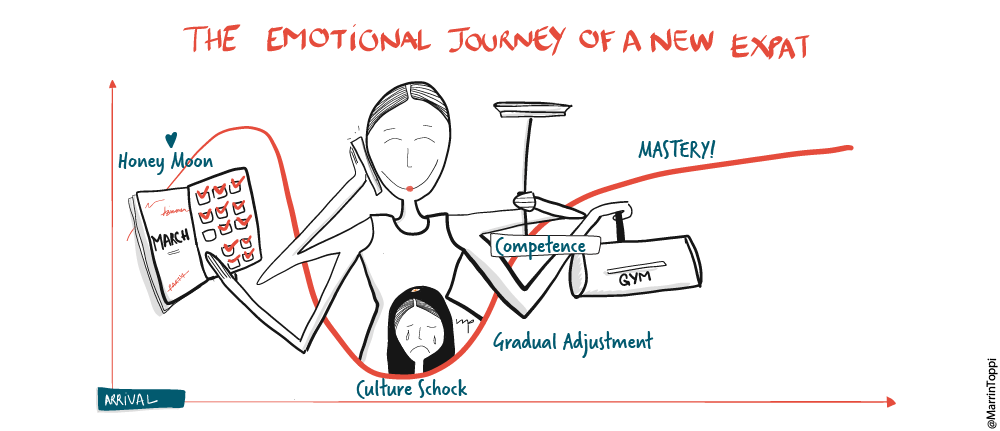
The U Curve of Expatriation
Illustration by Marine Pitto

The Emotional U-shaped Curve of Expatriation : to acknowledge it and to better live it

Have you ever heard of that famous emotional U-curve of an expat?

I was aware of it when I began my expat journey, and it has remained very relevant throughout the year, to me as well as to my entourage and to my coachees.

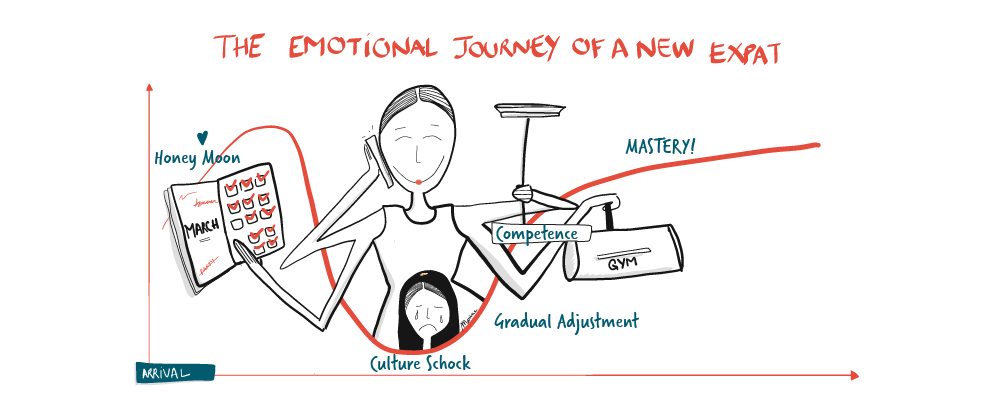
From the first phase of the « honeymoon » to the last where you finally found a balance and acquired a new “mastery” state of mind, you would have gone through a “cultural shock”, followed by a “gradual adjustment” and the “mobilization of your competences”.

This curve descends after the cultural shock and then rides up gradually… and fluctuates throughout the whole process until you reach the new “mastery” state of mind.

In Hong Kong, it is always easy to network and to meet new people. Most of the time, people put on a good face, and it is not easy to see that you are not the only one to experience the ups and downs of that curve.

Share your difficulties and you will understand that most of the expats are going through the same thing.

The emotional fluctuations that you’re going through could also be easily understood by people from your host country. Identify trustworthy people and dare to express yourself! A good start, in my view, is to find the support that you need.

Evaluate where are your needs thanks to Maslow’s pyramid

Another well-known model is the Maslow’s hierarchy of needs.

The model is often displayed as a pyramid. At the bottom of the pyramid are the physical needs : the basic requirements for safety and security.

Going up the pyramid comes the psychological and social needs: the needs of belonging, self-esteem and self-realization.

In my opinion, the Maslow model is a good tool to identify your needs and to become an actor of your expatriation.

Arriving in a new country, it is necessary to fulfill the basic needs of physical requirements (food, warmth, health…) and of safety and security (finding a decent place to live…). Connecting with people could be relatively easy: by joining a hobby group, connecting to other expats etc.

But what about the need of self-esteem when you are abroad? For people who work: is your work helping your self-esteem to grow? And for people who don’t work (which is the case for most of the spouses), how can you fulfill that need of self-esteem ?

As for the self-realization need: what could it be for you?

In order to enjoy your expatriation, you have to be able to answer these questions. It could also be the subject of a life coaching.

Evaluate where your needs are and what they mean for you will then enable you to transform an uncomfortable situation to a fulfilling experience.

To become an actor of your expatriation : what to do with that blank page

Instinctively, human beings tend not to like significant change. However philosophers from Antiquity (notably the Greek) to modern days (the so-called Mindfulness school) all teach us that experiencing change is precisely being in the now, being alive.

It is easy to avoid change in our everyday rituals, to stay within our entourage and to stick with our long-time forged identities from back home. Expatriation invites us to « let go » of these rituals, identities and habits and to explore new ones.

Expatriation is an opportunity to reinvent ourselves: how to better allocate our time and to choose with whom we want to hang out? How to explore our inner values and to realize our most precious dreams? How to work on the renewal of ourselves?

« As the suns that are young again climb in the sky, after they’ve passed through the deepest of drownings »

Charles Baudelaire

By Clémentine Pons
September 4, 2018

Categories
Expatriation News

Grow your confidence by doing and acknowledging your achievements

Grow your confidence by doing and acknowledging your achievements

There’s a always feeling of surprise, a certain self-questioning which arises when I read over my CV or even my professional profile,

“Oh yeah? I actually did all that?”

As an artist and as a freelancer, I always have to introduce myself to new people, which means I must continually demonstrate my self-worth. Sometimes, I manage to forget that all those experiences listed in my CV and in my profile, the recommendations and the trainings, all come together, giving me a sense of legitimacy while demonstrating my abilities.

I am one of the older members of the current Millenial generation, a “Xennial”, if you will. And I like how the young Millenials that I’ve met think about the professional world, now a place where tasks are rather fleeting, contracts are hard to come by, and one is always searching for a new job or a new project to undertake. These Millenials inspire me by their reflections and the choices they make, leading to the stances they take.

As for me, being an actress, I’m quite familiar with the irregularities which this Generation Y must face: after each project, as is the case with most actors, I must go to about 10 auditions before I’m able to land my next contract.

Therefore, it’s possible that my journey as an actress has not only allowed me to effectively display my acting abilities while also letting me put into practice the artistic training I have received, but it has also brought me a certain awareness of the uncertainty that we are faced with in the workforce.

As it turns out, this job insecurity which connects the majority of actors to the Generation Y could actually be the starting point for the reinvention of self, where one gets closer to their true aspirations: where one takes the leading role in their own life.

I am now a professional life coach, and I specialize in dealing with issues of self-confidence and assertiveness. I also went into therapy for several years, to explore my own psyche and its depths. This helps me to distance myself when I become aware of this surprise : “Oh yeah? I actually did all that?” Then I am able to connect the notion of self-confidence to a knowledge of myself and to my actions.

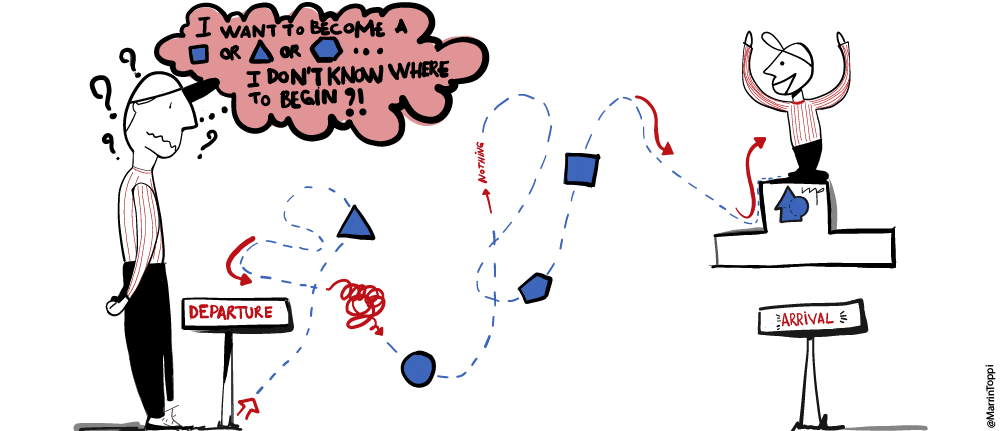
Illustration by Marine Pitto

The better you know yourself, the better you can appreciate yourself. The more you act, the more confidence you have. This surprise, “Oh yeah? I actually did all that?”, is something I often encounter when working with the women and men whom I coach. Little by little, through coaching, the recognition of your own inner-strength helps you take on life’s daily challenges, with the benefit of a renewed confidence. You are ready to risk taking action. You never thought that you’d be able to overcome your fears in this way. When starting your coaching experience, you often don’t even dare to think:

“Oh yeah? I could do all that?”

By Clémentine Pons
July 10, 2018